
Key points
- Nine active ingredients, all with doses disclosed — no proprietary blend.
- Four B vitamins at exactly 100% of the nutrient reference value (NRV).
- The botanical extracts are standardised, but several doses sit below the levels used in human trials.
- Capsules are vegetarian (HPMC shell); the product is gluten-, lactose- and GMO-free.
Neuro Boost ingredients list: the complete label
The figures below are transcribed directly from the NutriSolution Neuroboost Memory & Concentration label. Amounts are per serving — 2 capsules, which is the manufacturer's recommended daily dose. Each bottle of 60 capsules therefore provides 30 servings.
| Ingredient | Per serving (2 capsules) | Standardisation |
|---|---|---|
| Bacopa monnieri leaf extract | 240 mg | 25% bacosides (60 mg) |
| Gotu kola (Centella asiatica) aerial parts extract | 120 mg | 4% asiaticosides (5 mg) |
| Ginkgo biloba leaf extract | 120 mg | 24% flavone glycosides (28.8 mg), 6% terpene lactones (7.2 mg) |
| Alpha-lipoic acid | 25 mg | — |
| Huperzia serrata extract | 60.6 µg | 9% huperzine A (6 µg) |
| Vitamin B6 (pyridoxine hydrochloride) | 1.4 mg | 100% NRV |
| Vitamin B1 (thiamine hydrochloride) | 1.1 mg | 100% NRV |
| Vitamin B9 (folic acid) | 200 µg | 100% NRV |
| Vitamin B12 (methylcobalamin) | 2.5 µg | 100% NRV |
Other (inactive) ingredients: Vegetable capsule shell (hydroxypropyl methylcellulose); Bulking agent: acacia fibre; Anti-caking agent: magnesium stearate. The capsule shell is hydroxypropyl methylcellulose, so the product is suitable for vegetarians.
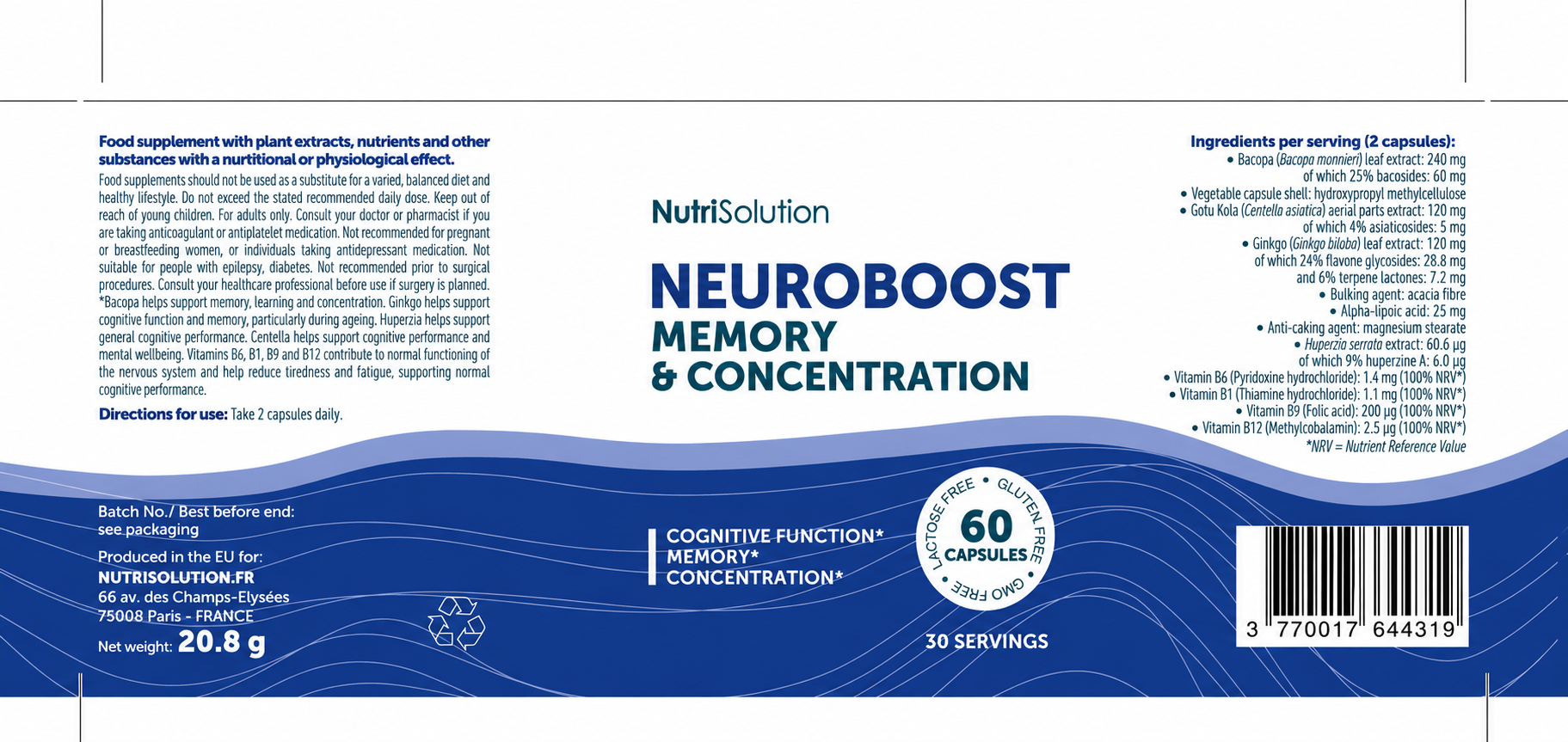
How to read this label
Three things on a supplement label matter more than anything else, and Neuro Boost discloses all three — which is not true of every product in this category.
- Amount per serving. Every figure here is for the full daily serving (2 capsules), not per capsule. Some brands quote per capsule to make numbers look bigger; this label does not.
- Standardisation. A herbal extract is only meaningful if the active compounds are measured. “240 mg of bacopa” tells you little; “240 mg standardised to 25% bacosides” tells you exactly how much of the active fraction you get. Neuro Boost states standardisations for all three botanicals and for huperzine A.
- NRV percentages. For vitamins, the label shows the percentage of the nutrient reference value — the daily amount considered sufficient for most adults. Each B vitamin here sits at exactly 100%, no more, no less.
How the doses compare with the research
The quick version before the detail: where each dose sits against the amounts used in human studies. The sections that follow explain what each row means.
| Ingredient | Per serving here | Typical research dose | Our take |
|---|---|---|---|
| Bacopa monnieri | 240 mg (25% bacosides) | 300 mg or more daily, for 8–12 weeks | Close, but below the most-studied dose |
| Gotu kola | 120 mg (4% asiaticosides) | Higher standardised doses | Human evidence at this dose is limited |
| Ginkgo biloba | 120 mg (24% / 6% standardised) | 120–240 mg of EGb-type extract | At the lower end of the studied range |
| Alpha-lipoic acid | 25 mg | 300–600 mg daily | Far below studied levels |
| Huperzine A | 6 µg | 50–200 µg daily | A token inclusion, not a researched dose |
| Vitamins B1, B6, B9, B12 | 100% NRV each | NRV is the daily reference value | Enough for authorised GB claims |
Ingredient by ingredient
Bacopa monnieri leaf extract — 240 mg
Standardisation: 25% bacosides (60 mg). A herb traditionally used in Ayurvedic practice. Human trials typically study 300 mg or more of extract standardised for bacosides, taken daily for at least 8–12 weeks.
Bacopa is a creeping herb with a long history in Ayurvedic practice, where it is traditionally associated with learning and memory. Its active compounds, the bacosides, are the part researchers standardise for. It is one of the few botanicals with several randomised, placebo-controlled trials behind it — mostly in healthy older adults, mostly over 8–12 weeks, and mostly at 300 mg or more of standardised extract per day. Our bacopa monnieri guide looks at that research in detail.
Gotu kola (Centella asiatica) aerial parts extract — 120 mg
Standardisation: 4% asiaticosides (5 mg). A traditional botanical. Human evidence at this dose is limited; most research uses higher standardised doses.
Gotu kola is a staple of traditional Ayurvedic and Chinese practice, sometimes called “the herb of longevity”. Modern human research into its effects on cognition is thin, particularly at the dose and standardisation used here, so it is best regarded as a traditional ingredient awaiting stronger evidence.
Ginkgo biloba leaf extract — 120 mg
Standardisation: 24% flavone glycosides (28.8 mg), 6% terpene lactones (7.2 mg). The standardisation matches the commonly studied EGb-type extracts, though many trials use 120–240 mg of a more concentrated extract.
Ginkgo is one of the most studied botanicals in the world, extracted from the leaves of one of the oldest tree species on earth. The classic research extract (EGb 761) is standardised to 24% flavone glycosides and 6% terpene lactones — the same ratio used here — and has been studied mainly for circulation and for cognition in older adults, with mixed results in healthy people. See our ginkgo biloba guide for the full picture, including its well-known interaction with blood-thinning medicines.
Alpha-lipoic acid — 25 mg
An antioxidant compound. Clinical studies generally use 300–600 mg daily — considerably more than the 25 mg in a serving.
Alpha-lipoic acid is an antioxidant compound the body makes naturally and that occurs in small amounts in foods such as spinach and offal. Most clinical research concerns diabetic nerve health at doses of 300–600 mg daily — many times the amount in a serving of Neuro Boost.
Huperzia serrata extract — 60.6 µg
Standardisation: 9% huperzine A (6 µg). Source of huperzine A, which affects acetylcholine breakdown. Research doses are typically 50–200 µg of huperzine A; a serving provides 6 µg.
Huperzia serrata is a Chinese club moss and the natural source of huperzine A, a compound that slows the breakdown of acetylcholine, a neurotransmitter involved in memory. Research doses are typically 50–200 µg of huperzine A per day; a serving here provides 6 µg, so this is best understood as a token inclusion rather than a researched dose.
Vitamin B6 (pyridoxine hydrochloride) — 1.4 mg
Standardisation: 100% NRV. Contributes to normal functioning of the nervous system and normal psychological function (authorised GB nutrition and health claims).
B6 is a water-soluble vitamin involved in making neurotransmitters and in normal nerve signalling. At 100% NRV it carries authorised GB claims — a genuine, if modest, contribution that any balanced diet also provides.
Vitamin B1 (thiamine hydrochloride) — 1.1 mg
Standardisation: 100% NRV. Contributes to normal functioning of the nervous system and normal psychological function (authorised GB claims).
Thiamine was the first B vitamin discovered, and severe deficiency causes well-documented neurological harm — which is why its role in normal nervous-system function is an authorised claim. Most adults eating a varied diet already reach the NRV.
Vitamin B9 (folic acid) — 200 µg
Standardisation: 100% NRV. Contributes to normal psychological function and the reduction of tiredness and fatigue (authorised GB claims).
Folate supports normal psychological function and helps reduce tiredness and fatigue — both authorised claims at the 100% NRV provided here. Folic acid is the stable, supplemental form of folate.
Vitamin B12 (methylcobalamin) — 2.5 µg
Standardisation: 100% NRV. Contributes to normal functioning of the nervous system, normal psychological function and the reduction of tiredness and fatigue (authorised GB claims).
B12 keeps nerves and red blood cells healthy, and deficiency — more common in older adults and people on restrictive diets — is a recognised, reversible cause of memory and concentration problems. The methylcobalamin form used here is the body's active form. Anyone suspecting a deficiency should ask their GP for a blood test rather than self-treating.
What “dose versus research” means in practice
When a botanical has been studied in humans, the trials use specific extracts at specific daily doses. A supplement can contain a genuinely promising ingredient yet provide too little of it to expect the studied effect. With Neuro Boost the gap is clearest for alpha-lipoic acid (25 mg here versus 300–600 mg in studies) and huperzine A (6 µg here versus 50–200 µg in research). The bacopa content is closer to studied levels but still below the most commonly used 300 mg.
The B vitamins are the exception: B1, B6, B9 and B12 are each present at exactly 100% NRV, which is enough to carry authorised GB claims about normal nervous-system and psychological function and reducing tiredness and fatigue. Those claims apply to the vitamins themselves — they are not evidence that the finished product improves memory.
Ingredient research is not product research
What the label cannot tell us
A label confirms what is in the bottle; it cannot confirm what the combination will do. The finished Neuro Boost formula has not been through a published clinical trial, so no one — including us — can state from evidence how these nine ingredients perform together, at these doses, in people. What we can say is where each dose sits relative to the research on its own, which is exactly what the sections above set out.
Are these ingredients safe?
The label's warnings are clearly stated: the product is for adults only, it is not recommended during pregnancy or breastfeeding, and it is not suitable for people with epilepsy or diabetes. Because ginkgo can affect blood clotting, anyone taking anticoagulant or antiplatelet medication is told to consult a doctor or pharmacist first — and the label says the same for antidepressant medication. Our safety and side effects guide goes through every warning on the label, in plain English.
Quality and manufacturing
The product is produced in the European Union for NutriSolution. The supplier's marketing references ISO 9001 and ISO 22000 certification of its manufacturing standards; these are quality-management and food-safety systems, which is reassuring for consistency and hygiene, though they say nothing about effectiveness.
Want the full picture?
See how the formula fits into our overall assessment, or check today's price on the supplier's site.